mercredi 17 décembre 2014

Cystic fibrosis: Explanations


Description of one genetic disease


The cystic fibrosisalso known as mucoviscidosis, is a genetic disease that affects mostly lungs but also the pancreas, liver, and intestine. Cystic fibrosis is due to a mutation of only one gene which is the one who help to produce CFTR (cystic
fibrosis transmembrane conductance regulator), a transmembrane protein that help Cl- and Na+ to pass through the membrane.


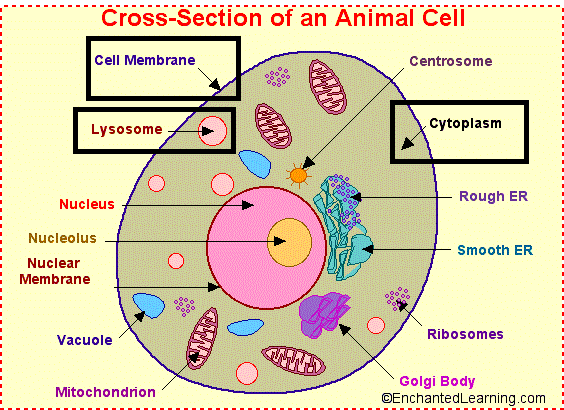
Where can we found it?

As we can see on the picture we can find these in the cell membrane, in lysosome and in the cytoplasm, in the early and late endosome.
http://www.enchantedlearning.com/subjects/animals/cell/


How does a protein problem lead to so much trouble?


http://healthylookout.com/?p=1145
On image 1, it's a normal CFTR: the canal is well opened and the mucus can not be accumulated over the membrane.

On image 2, it's a CFTR produced by a mutation: As we can see, the canal is closed and the result of a lack of NaCl in the mucus is a very sticky mucus that cover all the epithelium. Then the accumulation of this mucus causes respirator deficiency and infections.

jeudi 29 mai 2014

Co-transporters:

I) Historical:

   In august 1960 in Prague, the Czech Republic Robert K.Crane discovered the mecanism of the sodium-glucose cotransport for the glucose intestinal absorption. It was the most important concerning later the carbohydrates absorption in the 20th century.

II) What are these proteins?

    Co-transporters, or coupled transporters are a subcategory of transporters that couple the favorable movement of one molecule with its concentration gradient and unfavorable movement of another molecule against its concentration gradient.
    According to the path of these two elements, we'll talk about symporters (ion and molécule travel the membrane in the same direction) or antiporters (these two chemical species travel the membrane in opposite directions).

http://ressources.unisciel.fr/biocell/chap2/co/module_Chap2_2.html


Uniporters:

Uniporters are proteins which facilitate in one direction a molecule or an ion through phospholipids membranes such as the plasmic membrane. It's the opposite of the co-transporters (symporter or antiporter).
Source:Unknow


mardi 17 décembre 2013

Pumps Na+/K+ ATPase:

History:

Na+/K+-ATPase was discovered by Jens Christian Skou in 1957 while working as assistant professor at the Department of Physiology, University of Aarhus, Denmark. He published his work that year.
In 1997, he received one-half of the Nobel Prize in Chemistry "for the first discovery of an ion-transporting enzyme, Na+/ K+-ATPase."

Function: 

Export of sodium from the cell provides the driving force for several secondary active transporters , which import glucose, amino acids, and other nutrients into the cell by use of the sodium gradient.
 Failure of the Na+-K+ pumps can result in swelling of the cell. A cell's osmolarity is the sum of the concentrations of the various ion species and many proteins and other organic compounds inside the cell. When this is higher than the osmolarity outside of the cell, water flows into the cell through osmosis. This can cause the cell to swell up and die (the lyse). The Na+-K+ pump helps to maintain the right concentrations of ions. Furthermore, when the cell begins to swell, this automatically activates the Na+-K+ pump.


http://www.asso-etud.unige.ch/aecb/articles/notes_cours/1ere/biolobarja2011.pdf


lundi 16 décembre 2013

Aquaporins:


     1) Historical:

   These aquaporins have been discovered in 1992 by an american biologist named Peter Agre during a studying about red blood cells: it was during an experience about an injection of a "copy" of DNA (or RNAm) of a protein in an amphibian's egg. In 2003, the biologist was rewarded by the Nobel Prize of Chemistry.


     2) What is the aquaporin?

   At the human's body, aquaporins are really important for the operation of the kidneys. Cellulars have a plasma membrane which no accept the pass of the water. However, they have aquaporins which can pass the water easier through the cellular. In fact, thanks to hydrogen bonds (chemestry bond between  oxygen atoms and hydrogen atoms) and proteins' charges, that the water travel in the plasma membrane.


http://www.proteine.wikibis.com/aquaporine.php


===> More details in this video (1'53''). 


                                                                                           Back to home

mardi 5 novembre 2013

A little and general presentation:

Hi,
     We are two students currently in first year of our licence in the university of Bordeaux 1.
     Our goal is to share with you our research about bio cell, and more specifically about membrane's transporters.


     1) What are membrane's transporters, and what for?


   Such as an electrical battery, cells have a (negative) charge which is the opposite of the charge's outside of the cell. This difference of charge is caused according to the ratio of the sodium Na+ and the potassium K+, charged positively. if there is more K+ than Na+ in an environment, this one is negative, because of the important mass of chloride charged negatively. Otherwise, the environment has a positive charge.

   The distribution of charges between the inside of the cell and the environment outside has to be different for the fundamental role played in terms of functions of the cell.

   But, the permease lets diffusing some metabolites through the neighboring environments. In the long term, without a transport way which maintain the ratio Na+∕K+, there will have the same quantity of sodium and potassium on every environments. The cell will lose her negative charge, and will don't operate anymore.


   The membrane is impermeable to hydrophilic molecules. Membrane's transporters are proteins which allows metabolites to go through the cell's membrane. They are selective and control the flow of metabolites accurately.

   We can find two different membrane's transporters:


    Passive transporters : which do not need ATPase (a kind of protein) and need a gradient of concentration (ex: Aquaporin, Uniport). They can transport from 10 power 7 to 10 power 8 molecules per seconde. There are the fastest transporters.
        - Active transporters: which allows ions or molecules to pass trough the membrane against the gradient of concentration. (ex: Na+/K+ ATPase pumps). They can transport from 10 power 2 to 10 power 3 molecules per seconde.

   However, there is another type of membrane's transporter: co-transporters (symporter and antiporter)They can transport from 10 power 2 to 10 power 4 molecules per seconde.


     2) Why do we have chosen this topic?


   We found this topic interesting because it is about research on proteins which maintain cells to control  the electrochemical gradient (or balance charges' potential)  in the cell or in the extracellular matrix. Through articles in this blog, we'll show you in detail different possible ways of transport of these macromolecules, and how they do it.